School Communications: Three Priorities Emerging

Beyond the message: How districts are turning emerging communications priorities into practice
A couple of years ago, much of the conversation around school communications centered on telling your story, streamlining information, reducing communication overload and introducing specialist tools to help districts communicate more effectively.
That work is continuing, but the conversation is moving on.
Across recent industry webinars, annual surveys and emerging research, three priorities are coming into sharper focus for 2026/27:
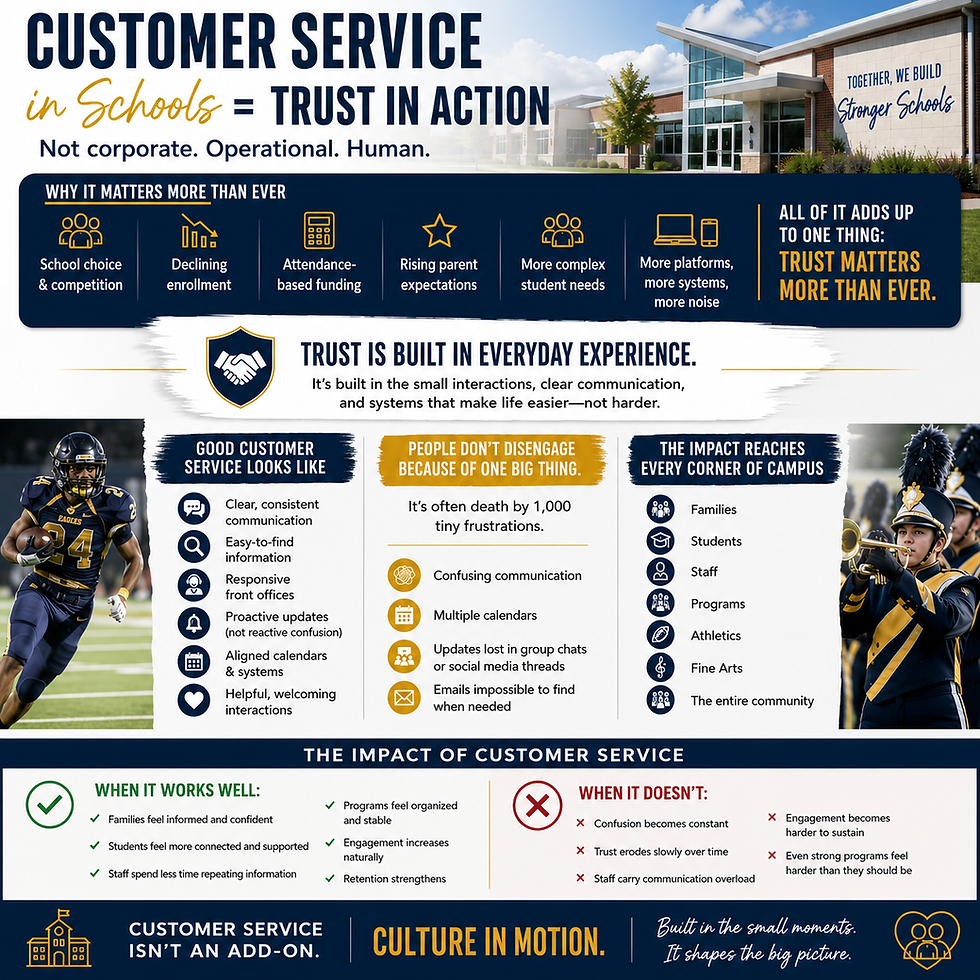
Family engagement and customer service
Improving the end-to-end experiences families have with their schools and programs
Scaling communications
Making information and support easier to access and deliver consistently throughout the organization
Empowering a communicator network
Enabling people across schools, departments and programs to play their part in a connected communications approach
AI, digital accessibility and program sustainability are all important parts of this conversation. But the bigger shift is towards recognizing the strategic importance of communications and understanding how districts can put systems and frameworks into practice at the campus and program level. Ultimately, school communications is connected to much bigger outcomes:
Communications → Enrollment
Experience → Retention
Storytelling → Competitive advantage

1. Family engagement and customer service: It's about the experience, not just the message
Families are making decisions based on more than academic results and school reputation. Their experience of a district, campus or program, from the first website visit to the everyday interactions that follow, can influence whether they inquire, enroll, stay or recommend that school or program to others.
Family engagement is the experience of being informed, supported, heard and connected to the school community. It goes beyond the messages sent or the events families attend. It includes how easily people can access information, ask questions, get help, share feedback and understand the opportunities available to their children. Recent research is reflecting that shift, looking beyond the messages districts, campuses and programs send, to the experiences families actually have.
What the research tells us about family engagement: Influence, trust, and customer service
ParentSquare and Hanover Research (October 2026): In a survey of 1,031 parents, 63% said communication quality had influenced their decision to stay at a school. It had influenced 56% when recommending a school, and 50% when choosing where to enroll. Although 85% of parents said they trust school communication, only 68% felt it was personalized.
Sogolytics (August 2026): Research involving 534 K-12 parents highlighted safety, support for individual learning and strong communication as important considerations when families assess whether a school is the right fit.
Apptegy/SchoolCEO (November 2026): Its District of Choice webinar explored how welcoming experiences influence school choice, including the value of school tours and the people who welcome prospective families. The webinar also discussed practical ways to assess the experience of prospective families, including testing how easy it is to arrange a tour, how quickly inquiries are answered and whether staff can help when they don't immediately know the answer.
NSPRA and Qualtrics (September 2026): While 75% of respondents said positive everyday interactions strengthen trust, only 38% considered their district very or extremely effective at delivering positive experiences. The findings highlight the challenge of creating a consistently positive experience across an entire district, where families interact with many different people, campuses, departments, programs and services.
Project Tomorrow and ClassDojo (October 2026): Their research found a 24-percentage-point gap between district leaders' perceptions of family satisfaction with school communication and families' reported satisfaction.
Finalsite (November 2026): Its 2027 District Communications Report found that the number of districts tracking student and family retention had more than doubled since 2025.
Alchemer (2026): Its K-12 Parent Trust Report found that 31% of parents felt schools asked for feedback but rarely acted on it. A further 17.5% said they had never been told how their input influenced a decision.
There are some great practical examples, too.
Apptegy/SchoolCEO highlights Oskaloosa Schools in Iowa for its student-led tours, giving prospective families an opportunity to see the school through the eyes of the students who experience it every day. Meanwhile, ParentSquare's October website roundup showcased districts such as Syracuse City School District and Galveston ISD, making essential information and frequently used services easier for families to find online.
Think about 'experiences' from a parent's perspective. Finding information or getting help should feel straightforward, even when their question involves several departments, activities or people. They shouldn't have to understand how the organization is structured to find the information or support they need.
The takeaway: It's the experience that counts
These might seem like relatively small things, but families remember how easy it was to book a tour, find a registration form, or get an answer to a question. Those interactions help shape their overall impression of a school or program. A good newsletter alone won't fill every empty seat. What matters is how families experience the organization at every point of contact, both digital and in person.
Good customer service is easier to deliver when people have access to the right information, know where to direct questions and have clear ways to follow up. Families should receive helpful, timely responses regardless of which department, campus or program they contact. That means giving clear answers, making sure questions reach the right people, following through and showing that feedback has been heard. Asking for feedback is a good start; disappearing into a committee with it is less helpful.
When families have choices, the experience a district, campus or program delivers can help demonstrate its value. Enrollment and retention have real financial implications, making this much more than a marketing conversation.
The aim isn't to change the way people care for or support families. It's to make sure the information, processes and organizational support are there to help them do it well.
The examples in the following tables include familiar school roles, such as principals, band directors and coaches, but the principles apply much more widely. Many people across a district, campus or program contribute to communicating with and supporting families.
The organizational change | How this helps staff | What families experience |
Clear information about enrollment, programs, schedules, costs and expectations | Principals and program leaders have useful, accessible information to support conversations with prospective families | Families can understand what's available, what is involved and how to take the next step |
Easy-to-find information about visits, registration and getting involved | Staff spend less time directing families between departments or searching for basic information | Families can find forms, arrange a visit and understand how to get involved without having to make several calls |
Clear routes for questions and feedback | Staff know where to direct questions and who is responsible for following up | Families know who can help and feel their questions and concerns are being heard |
A consistent, helpful approach to customer service | Staff have shared guidance and support to help them respond to different situations | Families receive helpful, timely responses regardless of who they contact |
2. Scaling communications: Making good communication easier to deliver
As districts become more complex, the challenge is not just communicating more effectively. It's making effective communication possible to deliver across more people, departments, campuses and programs without creating additional workload or confusion.
Technology is creating new ways to improve access, responsiveness and efficiency, but that doesn't automatically mean families will have a better experience. Having the right technology is only part of the answer. The processes behind it matter just as much.
What the research tells us about communication systems: Platforms, processes and AI
Finalsite (November 2026): Its 2027 District Communications Report found that 67.1% of respondents said families very often or sometimes need staff assistance with forms, payments and registration. More than half identified separate systems and multiple logins as barriers.
Project Tomorrow and ClassDojo (October 2026): Their research found that districts used an average of 2.3 communication platforms simultaneously, with 36% using three or more.
ParentSquare (August and October 2026): Its website AI Assistant examples include Flagler Schools in Florida and Pasadena ISD in Texas, where families can ask questions about enrollment, calendars, transportation and other school information.
Finalsite (November 2026): Its reporting highlights the potential of website AI assistants to support families outside normal office hours, with 50% of questions submitted arriving outside school hours. At Wylie ISD, the chatbot answered 10,500 questions in just a few months, saving the district an estimated 1,096 staff hours.
AI assistants are an interesting development, particularly when families need answers outside office hours. But they can't fix outdated website information, unclear processes or a lack of follow-through from a department responsible for responding. In addition, they may not necessarily scan information stored on third party/connected websites.
Scaling communications is about making good practice repeatable across district departments, campuses and programs, without relying on individuals to continually recreate information or processes. It means using technology to reduce routine work, improving access to information, simplifying processes and providing staff with the guidance to communicate effectively.
For staff, that might mean having an agreed calendar rather than maintaining several different versions, a ready-to-use template rather than starting from a blank page, or a single reliable place to check information before responding to a parent. None of these changes is particularly glamorous, but they can save time, reduce frustration and make the working day a little easier.
It also means looking at where families experience friction. If submitting a form requires three logins, two phone calls and a degree in detective work, the problem probably isn't the family's willingness to engage!
The takeaway: Make good communication easier to deliver
Scaling isn't about sending more messages or adding more platforms. It's about making communication easier to deliver, access and act upon across the entire organization.
The organizational change | How this helps staff | What families experience |
Shared calendars and agreed communication channels | Principals, band directors and coaches can update information in agreed places, rather than having to repeat the same update across several channels. | Families can find event details and changes without piecing together conflicting updates |
Reusable templates and streamlined processes | Staff have a starting point for routine communications instead of creating everything from scratch | Information is clearer and more recognizable, even when it comes from different departments or programs |
Connected systems and less duplication | Staff spend less time entering, checking and sharing the same information across different platforms | Families aren't repeatedly asked to provide the same details or check multiple places |
Clear processes for keeping online information current | Staff know who is responsible for updates and aren't left guessing whether information elsewhere is still accurate | Families can find reliable answers without having to call the school office to double-check |
3. Empowering a communicator network: Turning strategy into practice
Here's the thing: good communication doesn't happen in one department. A district communications team can't personally manage every family interaction, explain every program opportunity or create every campus update. Nor should they be expected to.
Their role is increasingly about giving others the tools, guidance and confidence to communicate effectively, rather than trying to manage every interaction themselves. Consistency doesn't mean every campus, department or program has to sound the same. It means families know what to expect, staff understand their responsibilities and information is coordinated and aligned across the organization.
What the research tells us about shared responsibility: Governance, training, expectations
NSPRA and Qualtrics (September 2026): 58% of respondents said their districts lacked formal, documented expectations for staff interactions with external audiences, while 49% said they had no formal customer service training.
Finalsite (November 2026): Its report reflects the changing role of district communications, with growing emphasis on outcomes such as enrollment and retention, alongside the need for clearer guidance and governance. Almost 87% of respondents said their teams used AI, but only 21.7% had formal written AI guidelines.
ParentSquare (October 2026): Its district website examples demonstrate how consistent access to information can sit alongside the individual identity and priorities of each school community.
A practical example of this approach can be seen at Lake Belton High School Band in Texas. Its 2026-27 Stampede Communication Guide clearly explains who communicates what, where families should look for information and how they can get involved. While so many apps isn't necessarily considered best practice, this webpage brings together director updates, booster information and volunteer opportunities, giving families a clear understanding of where to find information and who is responsible for sharing it.
A similar webpage could potentially be adapted across programs and campuses throughout the district, creating familiarity for staff and families. Think about a new parent joining a marching band, or a family trying to understand how to get involved in football. They may need information from the director or coach, the booster organization, the school office and the district. If those people understand their roles and know where information belongs, the experience is much easier for everyone. Families aren't left joining the dots, and staff aren't left trying to fill in the gaps.
The lesson isn't that every program needs the same collection of apps. It's that communication responsibilities and expectations should be clear. This is where district-level strategy becomes important. District communications can provide shared standards, channel guidance, templates, resources, training and ongoing support, allowing campuses and programs to contribute without having to build their own communication systems from scratch. The aim is to better support and connect the people already communicating with families.
Campuses and programs bring the local knowledge, relationships, activities and opportunities that make their communities distinctive. The district provides the framework that helps those contributions connect.
The takeaway: Everyone has a part to play
A communicator network isn't about making everyone a communications specialist. It's about equipping the people already communicating with families to do it well, consistently and confidently.
The organizational change | How this helps staff | What families experience |
Clear communication responsibilities across district, campus and program teams | Teachers, office staff, principals and program leaders understand their role and aren't left wondering who should respond or share information | Families know where to look and who to contact |
Shared guidance and practical training | Staff have the confidence to answer common questions, handle inquiries and know when to seek help | Families receive helpful, consistent answers from different people |
Access to district communications support and resources | Campus and program staff don't have to develop their own communication standards or work everything out independently | Information feels connected across the district, while still reflecting the individual school or program |
Better connections between district, campus and program teams | Staff can draw on the knowledge and support of others rather than feeling they have to manage communication in isolation | Families benefit from people who know where to find answers and can connect them with the right person |
From emerging ideas to everyday practice
These developments point to a broader change in how school communications is being approached. Family engagement and customer service are becoming increasingly important to how schools attract, support and retain families. Technology and better processes are helping make communication easier to deliver consistently at scale, while communications teams are increasingly enabling people across the organization to play their part.
There are wider organizational benefits, too. Clearer expectations, better coordination and accessible information can reduce duplication, save staff time and make everyday work easier.
Ultimately, this isn't about the communications department doing more, or asking everyone else to take on more. It's about giving people the support, information and processes they need to work better together.
The districts, campuses and programs making progress aren't necessarily the ones with the most channels, the biggest social media following or the newest technology. They're the ones finding ways to connect people, processes and information so that good communication becomes part of how the organization operates.
That's what turning communications strategy into everyday practice looks like.
Sources and further reading
Apptegy/SchoolCEO - November 4, 2026:
Alchemer - 2026:
Finalsite - November 5, 2026:
NSPRA and Qualtrics - September 2026:
ParentSquare and Hanover Research - October 2026:
Project Tomorrow and ClassDojo - October 2026:
Sogolytics - August 2026:
Practical Examples
Apptegy/SchoolCEO
Finalsite
Lake Belton High School Band – August 17, 2026:
ParentSquare